
What Is Wire Gauge?
Wire Gauge is a standardized way to describe a conductor’s thickness and current-carrying capacity. The gauge indicates the wire’s physical size, while the conductor material, insulation, installation method, and circuit load also affect proper selection. Smaller gauge numbers generally identify thicker conductors, which can carry more current than thinner conductors.
Quick Facts About Wire Gauge
Category
Electrical measurement
Used for
Matching conductors to circuit loads
Common confusion
Wire size is not the same as voltage
Typical tool
Wire gauge reference or stripping gauge
Also called
Wire size, AWG
Often discussed with
Electrical Code Correction
Key Takeaways About Wire Gauge
- Gauge numbers run opposite to conductor thickness.
- Correct selection depends on the complete circuit.
- Gauge does not identify voltage by itself.
How Wire Gauge Works
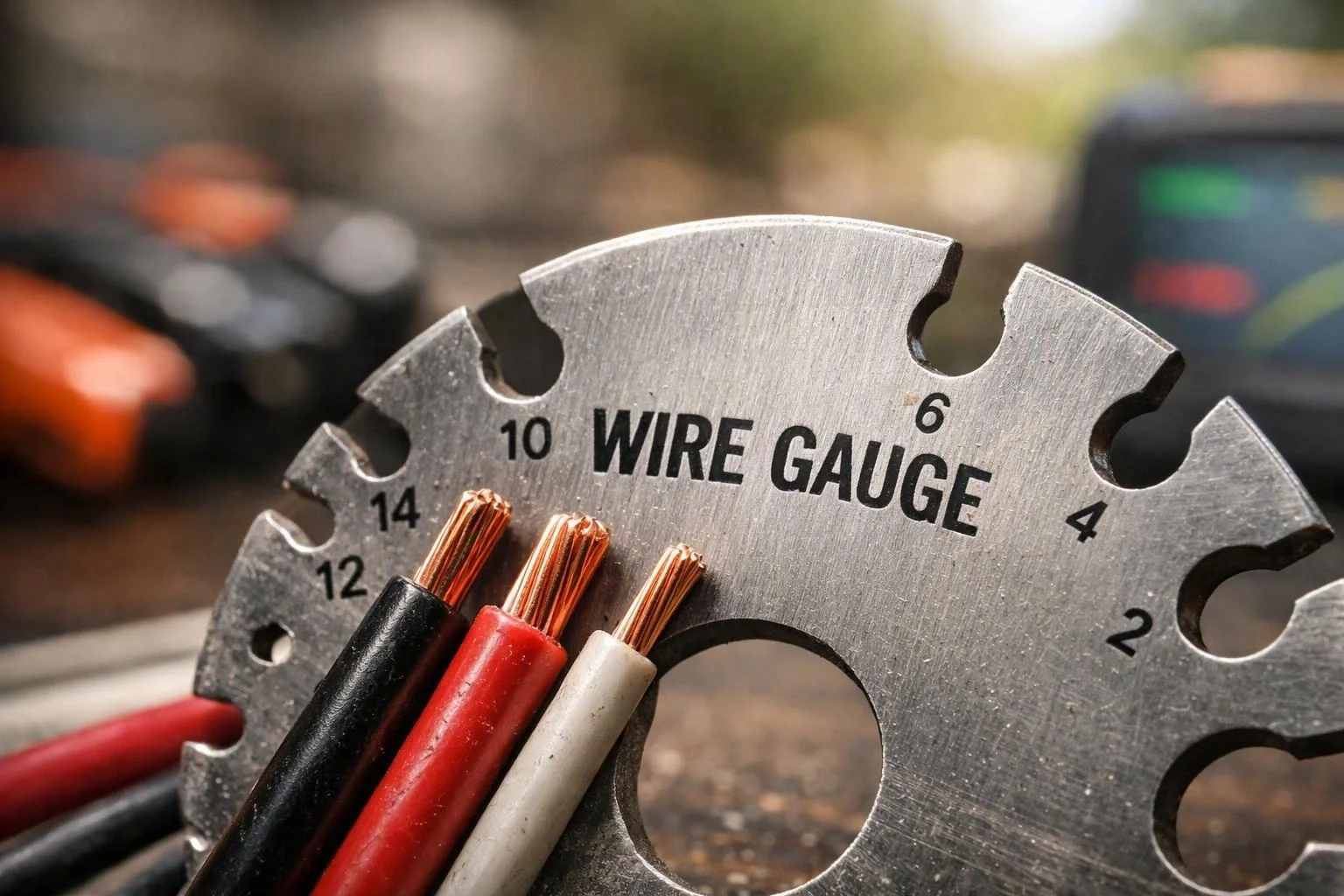
Wire Gauge identifies a conductor’s size through a standard numbering system. In this system, a smaller gauge number usually represents a thicker conductor. A thicker conductor has less electrical resistance and can carry more current under suitable installation conditions.
Related glossary terms: Electrical Load, Overcurrent Protection, Voltage Drop.
Wire selection also depends on conductor material, insulation, circuit length, ambient conditions, and overcurrent protection. A label may show the gauge alongside other information about the cable. During an Electrical Code Correction, the listed wire size is compared with the circuit equipment and installation conditions. A Voltage Drop check may also be relevant when a circuit travels a long distance.

From the Center Electric Service team
When we inspect wiring for an Electrical Code Correction, we identify the conductor marking and compare the wire gauge with the connected equipment and protective device. We also check terminations, insulation condition, and installation method, because a gauge label alone does not describe the entire circuit.
Wire Gauge in Practice: A Real-World Example
An electrical code correction may involve a branch circuit whose conductor size does not match the connected equipment or overcurrent protection. We review the cable marking, circuit path, and terminations before selecting a compliant correction.
Related Services
Related Terms
Electrical Load
Electrical Load is the amount of power that connected devices and equipment draw from an electrical…
Overcurrent Protection
Overcurrent Protection is a system of devices and conductors that limits current when a circuit carries…
Voltage Drop
Voltage Drop is the reduction in electrical pressure that occurs as current travels through a conductor…
Conduit
Conduit is a protective raceway that surrounds and guides insulated electrical wires or cables. It may…
Center Electric Service
Have Questions About Wire Gauge?
Contact Center Electric Service for practical guidance on Wire Gauge and related electrical services work in Riverside.